
AI Real Estate Assistant vs Virtual Assistant – Which Is Better for Your Business?
In today’s competitive market, every real estate inquiry matters. A single website visit, call, or message can turn into a high-value client, especially when supported by smart AI agents for real estate.
But only if your response is fast and your follow-up is consistent. Most agents are already busy with showings, negotiations, paperwork, and meetings, making it hard to stay on top of every lead.
Using an AI real estate assistant or AI voice agent for real estate ensures every inquiry is captured instantly, improving response time and preventing missed opportunities.
That’s why modern real estate professionals now prefer AI agents for real estate and virtual assistants to streamline lead handling and daily workflow.
AI assistants work 24/7, handling lead qualification, appointment scheduling, and automated follow-ups for real estate, which significantly reduces manual workload. Virtual assistants add a personal touch, managing tasks remotely with flexibility and human judgment. Choosing the right support for your real estate business depends on whether you need fast automation with AI agents for real estate or personalized human-driven assistance.
Choosing the right support for your real estate business depends on whether you need fast automation with AI agents for real estate or personalised human-driven assistance.
Understanding how each system works helps you save time, boost lead conversions, and scale your real estate business with smarter automation tools.

Summary
- AI handles repetitive, high-volume real estate workflows automatically, while virtual assistants manage complex, sensitive, or relationship-driven work.
- AI Benefits: AI agents for real estate automate lead qualification, appointment booking, and AI-powered follow-ups, ensuring no opportunity is ever missed.
- Virtual Assistant Benefits: Offers human judgment and personalised communication, making it ideal for real estate tasks that need context, empathy, or nuanced conversations.
- AI Use Cases: Manages instant lead responses, updates your real estate CRM automatically, and handles basic customer support across all channels.
- Virtual Assistant Use Cases: Handles personalised follow-ups, complex scheduling, and real estate marketing tasks that require a human touch.
- Key Differences: AI is fast, consistent, scalable, and cost-effective for real estate operations, while virtual assistants offer adaptability, emotional intelligence, and high-quality handling of complex tasks.
- Combined Approach: Use AI Agents for Real Estate for repetitive automation and rely on virtual assistants for relationship-focused work to achieve the best results. This improves efficiency, lead conversion, and client satisfaction.
Actionable Takeaway: Integrate AI assistants and virtual assistants strategically to save time, streamline workflows, enhance client communication, and grow your real estate business efficiently.
Table of Contents
What Is an AI Real Estate Assistant?
An AI real estate assistant is an advanced automation tool designed to handle routine real estate tasks, improve lead response speed, and support agents with AI-powered workflows.
It can chat with leads, answer property-related questions, qualify buyers or renters, and manage follow-ups automatically using AI agents.
AI assistants work through chat, voice, SMS, email, and CRM integrations for real estate systems, responding the moment a lead reaches out.
Its purpose is simple: help you handle more leads in less time and ensure no opportunity slips away, especially when using AI agents for real estate to support your daily workflow.
Best For
An AI real estate assistant tool works best for:
- Agents who want faster, automated lead responses.
- Real estate teams handling a high volume of daily inquiries.
- Brokerages that need 24/7 coverage.
- Businesses that rely on website, portal, or social media leads
- Anyone who wants consistent follow-ups without manual effort
Examples of AI Real Estate Assistants
Lindy AI: Customizable platform that integrates with 3,000+ tools, handles scheduling and drafts listing descriptions.
Gabbi.ai: Built by top agents. It keeps leads warm. It tracks all talks (texts, calls, and emails).
Custom AI Assistant for Real Estate: A tailored system for your specific needs.
Pros of AI Real Estate Assistants
- No delays, even at night or during busy hours.
- It handles every inquiry across all channels.
- Provides AI follow-up automation for real estate.
- Works the same whether you have 20 leads or 2,000.
- One system can replace many repeated workflows.
- Every talk and action is saved for review.
Cons of AI Real Estate Assistants
- Not ideal for emotional or sensitive talks.
- You must train it to match your process.
- Limited with complex negotiations or custom tasks.
- Poor CRM data reduces its performance.
What Is a Virtual Assistant for Real Estate?
A virtual assistant (VA) for real estate is a trained professional who works remotely to support daily tasks. They handle admin work, client communication, scheduling, research, and other duties you want to delegate. Many VAs come with real estate experience, so they understand listings, documents, and standard industry workflows.
Best For
A virtual assistant works best for:
- Agents who need help with admin tasks
- Brokerages managing large transaction pipelines
- Teams that want human oversight for sensitive client conversations
- Agents who prefer human-managed communication
- Businesses with complex or changing workflows
Examples of Virtual Assistant
- Email and inbox management
- Scheduling calls, meetings, and property tours
- Data entry and CRM updates
- Listing uploads and property research
- Managing paperwork during transactions
- Social media updates and basic marketing tasks
Pros of Virtual Assistants
- Ideal for emotional or personal conversations.
- Can switch between admin, marketing, and client support.
- Handles situations that need context or nuance.
- Easily adapts to your unique workflow.
- Especially during negotiations or closings.
Cons of Virtual Assistants
- Most VAs follow a fixed schedule.
- They may not reply instantly to every lead.
- More expensive as the workload increases.
- They must learn your systems and style.
- Quality depends on the individual VA.
Key Differences Between AI Real Estate Assistant and Virtual Assistant
Choosing between an AI real estate assistant and a human VA needs understanding their strengths and weaknesses. The table highlights the main differences:
| Feature | AI Real Estate Assistant | Virtual Assistant |
|---|---|---|
| Cost | Usually cheaper, one AI can handle a lot of work for a flat monthly fee. | Usually more expensive; you pay hourly for a person’s time. |
| Availability / Response Time | Works 24/7, never takes breaks or holidays. | Works fixed hours, may take time off or be unavailable after hours. |
| Scalability & Lead Handling Capacity | Highly scalable, can process many leads at once with no extra staff. | Limited by human capacity. Scaling requires hiring more VAs. |
| Task Suitability | Best for repetitive, rule-based, data tasks (lead qualification, scheduling, standard replies), follow-ups. | Best for complex tasks, negotiation support, sensitive talks, problem-solving, and flexibility |
| Consistency | High consistency. Every lead gets the same standard process. No fatigue. | Quality can change based on the VA’s experience or workload. |
| Human Touch & Judgment | Very limited, cannot truly empathize or adapt to unusual situations. | Slower, needs time for hiring, training, and building trust. |
| Setup Time | Usually faster, deploy software and set workflows in days to a few weeks. | Weeks for hiring, onboarding, and training your specific systems. |
| Flexibility & Adaptability | Good for standard workflows. Less flexible when unique situations arise. | Highly flexible, can adapt instantly, handle exceptions, and custom needs with judgment. |
| Privacy, Data Handling & Control | Data handling is automated; it depends on the provider’s security. | Human-based handling, you control confidentiality and context more directly. |
AI Real Estate Assistant vs. Virtual Assistant Use Cases
To help you decide where to invest your resources, here is a simple breakdown of the specific use cases each assistant is best equipped to handle:
| Core Function | AI Assistant Use Cases | Virtual Assistant Use Cases |
|---|---|---|
| Leads & Response |
|
|
| Scheduling & Logistics |
|
|
| Property Information & Data |
|
|
| Administrative & Paperwork |
|
|
| High-Volume Communication |
|
|
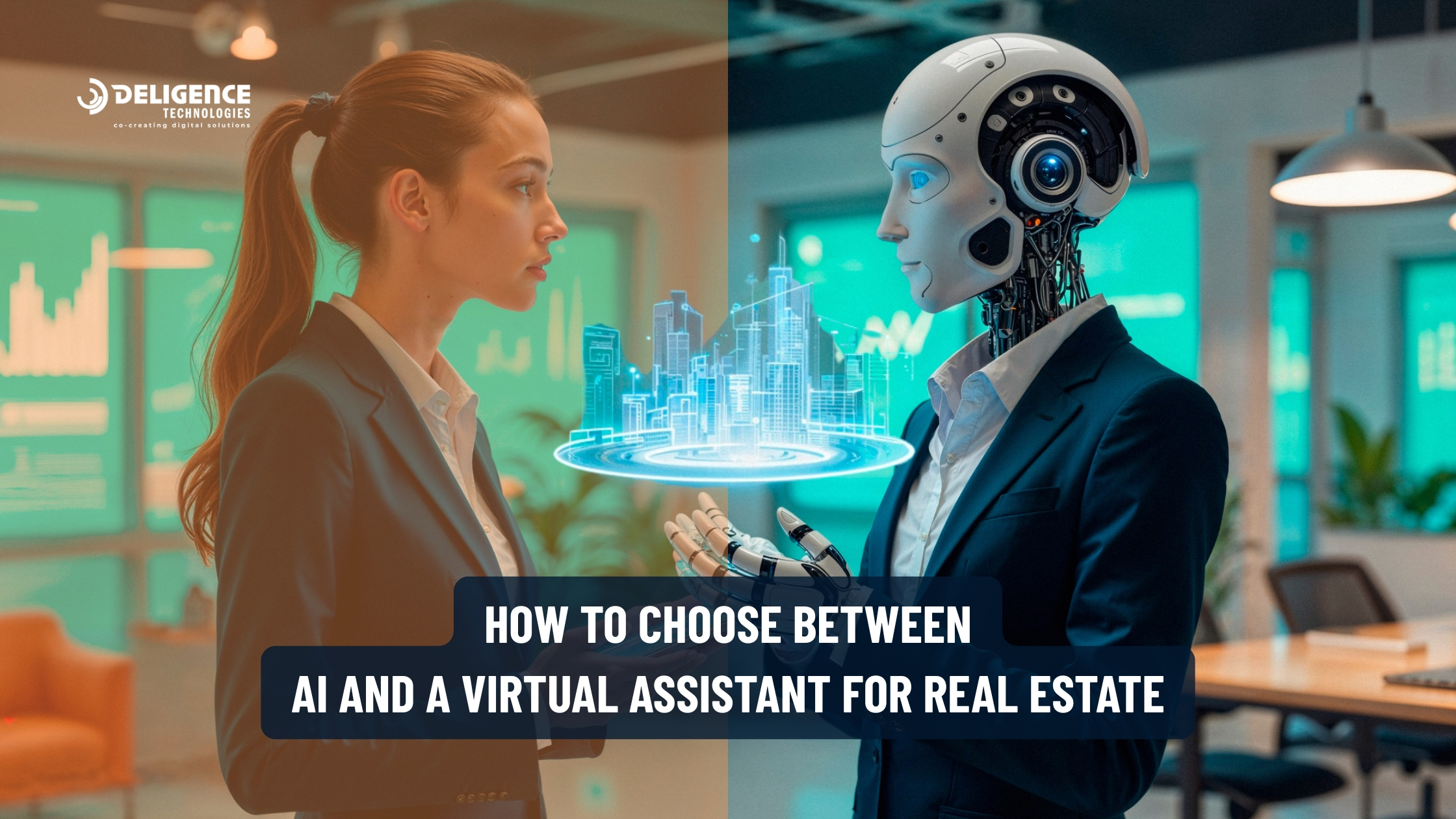
How to Choose Between an AI and a Virtual Assistant for Your Real Estate Business
Choosing between an AI real estate assistant and a virtual assistant depends on how your business works, the volume of leads you handle, and the type of tasks you want to offload. Solutions like OpSpring.ai and EliseAI offer AI tools for real estate that streamline lead capture, appointment scheduling, and workflow automation, giving agents more time to focus on closing deals.
Here’s how to decide what fits best:
1. Assess Your Lead Volume and Response Needs
If you handle many inquiries daily, an AI assistant is ideal. It responds instantly, qualifies leads in seconds, and never misses a message.
If your lead volume is moderate and requires more personal conversations, a virtual assistant might be a better fit.
2. Evaluate Your Budget and ROI Goals
AI assistants are more affordable long-term because they automate repetitive tasks and scale without adding extra cost.
Virtual assistants cost more as workload increases, but offer nuanced communication and human support.
3. Consider Your Business Model and Client Base
If your focus is speed, automation, and lead conversion, AI gives you a competitive edge.
If your clients expect personalized attention or emotional support like luxury buyers or long-term investors, a virtual assistant adds a more human touch.
4. Determine Task Complexity Requirements
AI handles structured tasks, answering FAQs, booking appointments, qualifying leads, and sending follow-ups.
A virtual assistant handles complex tasks, negotiations, transaction coordination, sensitive client conversations, or problem-solving.
Conclusion
Choosing between an AI real estate assistant and a virtual assistant comes down to what your business needs most. If you want faster responses, consistent follow-ups, and support that works around the clock, AI is the stronger choice. If your work involves emotional conversations, complex tasks, or highly personal client interactions, a virtual assistant adds the human touch you need.
Most real estate teams benefit from using both AI to handle repetitive tasks and lead qualification, and a virtual assistant for relationship-driven work. This balance helps you stay responsive, organized, and focused on closing more deals.
If you want to see how AI agents for real estate can plug into your current workflow, Deligence Technologies can help you set up an AI real estate agent that handles lead capture, follow-ups, and scheduling in just a few days.